Every custom vinyl project runs into the same wall at some point: the music does not care how you imagined the record looking. A twenty-eight minute set of songs will not sit comfortably on one side of a 7-inch single no matter how badly you want that format, and a four track EP pressed across a full 12-inch at 33 RPM will leave half the playing surface empty. Before you choose a size, a color, or a jacket, the smartest first move is to add up your running time and let that number point you toward the right pressing.
Start with your track list, not the format
The single most useful piece of information you can bring to a pressing is the total run time of your audio, split by side. A record has two sides, and the audio has to be divided between them in a way that respects both the physical capacity of the format and the natural break points in your music. If your material is thirty-eight minutes long, you are looking at roughly nineteen minutes per side, which fits a standard 12-inch at 33 RPM with room to spare. If it is fifty-two minutes, you are either pushing a single record past its comfortable limit or moving to a double LP. Knowing that number first turns every later decision into a simple yes or no.
Side breaks matter as much as total length. Vinyl is not like a streaming playlist that flows without interruption. The listener physically flips the record, so the last track of side A and the first track of side B carry weight. Sequencing your songs so the sides land close to equal length, and so each side ends on a track that earns a pause, is part of the job. Wildly uneven sides, say twenty-four minutes against nine, waste capacity and often mean the shorter side could have been cut louder.
What each size and speed actually holds
Two variables set the capacity of any record: its diameter and its rotational speed. Bigger discs have more surface area for grooves, and slower speeds pack more time into the same space because the groove travels a shorter distance each second. The figures below are the comfortable targets most cutting engineers work to before sound quality starts to degrade, not the absolute maximums.
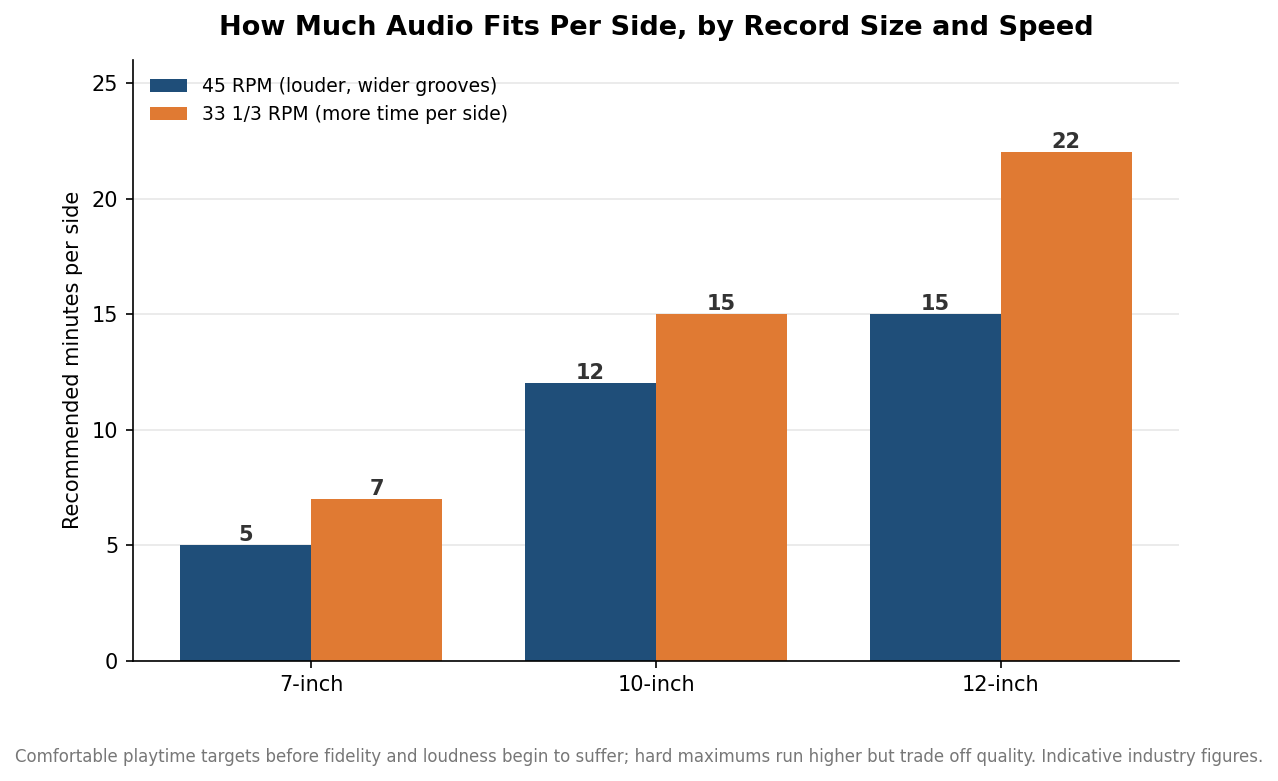
A 12-inch at 33 1/3 RPM is the workhorse of the album format, holding around twenty-two minutes per side in practice. Drop to 45 RPM on that same 12-inch and you get roughly fifteen minutes per side, but the audio is cut louder with a wider dynamic range, which is why audiophile reissues and club-oriented dance pressings favor it. The 7-inch is the classic single: about five minutes per side at 45 RPM, or closer to seven if you slow it to 33. The 10-inch sits in between and has become a favorite for short EPs and specialty releases, offering something like twelve to fifteen minutes per side depending on speed.
These numbers are guidelines rather than hard stops. Engineers can and do push more time onto a side, but every extra minute has a cost that is easy to overlook until you hear the finished record.
The tradeoff nobody mentions: length versus loudness
Here is the part that surprises first-time buyers. The more music you squeeze onto a side, the quieter and thinner it has to be cut. Grooves have to be narrower and closer together to fit, which reduces the amplitude the cutting head can carve, so a heavily packed side plays back at a lower volume and with less low-end punch than a sparse one. Push far enough and you also invite tracking problems, where the stylus struggles to stay in the groove, especially toward the center of the disc where the available groove speed is lowest.
This is why the inner tracks of a long side often sound duller than the openers, an effect known as inner-groove distortion. It is also why a bass-heavy record benefits from shorter sides and, frequently, from 45 RPM. If your music lives on deep low frequencies and dynamic swings, do not fill a side to its maximum. Leave headroom and the pressing will reward you with a louder, cleaner cut. If your material is quieter and more midrange focused, spoken word or acoustic music for example, you can run longer sides without much penalty.
How run size drives the price per record
Once the format is settled, quantity becomes the biggest lever on cost. Pressing vinyl carries a real one-time setup expense, generally somewhere in the range of eleven hundred to three thousand dollars for lacquer cutting, plating, and the stampers that actually mold your records. That cost does not change whether you press one hundred copies or one thousand, so it dominates the math on small runs and nearly disappears on large ones.
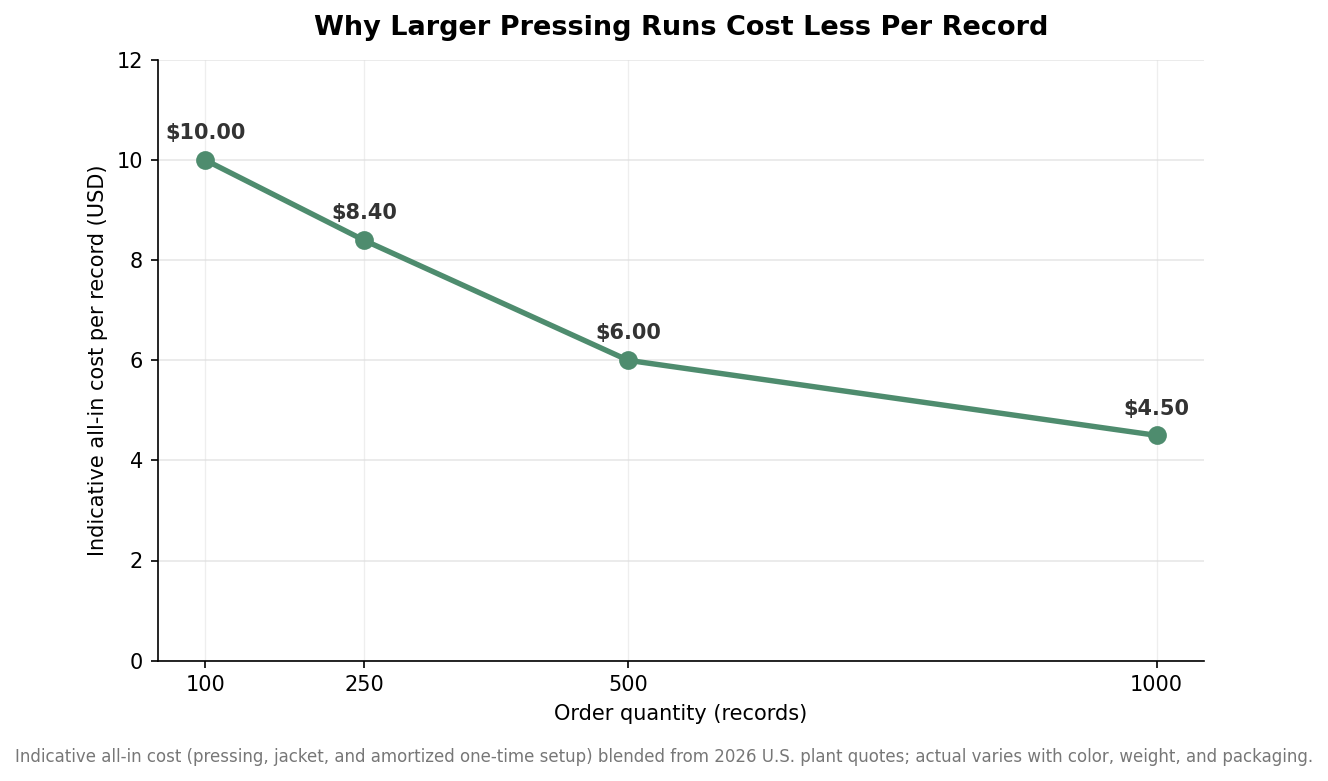
In concrete terms, a short run of one hundred 12-inch records in printed jackets often lands near a thousand dollars all in, which works out to roughly ten dollars per finished record. Move up to two hundred fifty copies and the per-record figure typically falls to the mid eight dollar range; at five hundred to a thousand copies it commonly settles somewhere between four and six dollars each, depending on color, weight, and packaging. The exact numbers shift by plant and by season, and these are indicative blended figures rather than a quote, but the shape of the curve is consistent everywhere: the setup cost spread across more units is what makes larger runs cheaper per copy. Most buyers find the economics start to make sense somewhere around two hundred fifty to five hundred units.
Weight and finish add real money too. Standard pressings use 140 gram vinyl, while a 180 gram upgrade adds heft and a more premium feel at a per-unit cost. Colored, splatter, and marble effects, gatefold jackets, and printed inner sleeves all stack onto the base price. None of these change how much music fits, but they change the budget, so decide on quantity and format before you start adding finishes.
Matching format to the project
Pulling it together, the format should follow the music and the audience. A two or three song single or a promotional giveaway is a natural 7-inch, cheap to produce in volume and instantly recognizable. A short artistic statement of fifteen to thirty minutes suits a 10-inch or a single 12-inch, with 45 RPM worth considering if fidelity is the priority and the run time allows it. A full album lives on a 12-inch at 33 RPM, and anything past about forty-five minutes total should move to a double LP rather than being crammed onto one disc at the expense of sound.
Lead times are the last thing to plan around. Standard turnaround at most plants currently runs about seven to nine weeks from approved masters and artwork, with expedited service in the four to six week range for an added fee, and both can stretch during busy seasons. Lock your running order and side breaks early, confirm the format against the capacity your audio actually needs, and the rest of the project, from color choice to jacket art, becomes a matter of taste rather than a scramble against the physics of the groove.
Win Free Stuff
Enter below for a chance to win plus receive 10% off your first order.
🎉 You are in!
Check your email for your 10% off code. Good luck!